How A3L-FEC works
A³L-FEC is an application-layer packet-generation and flow-control algorithm over UDP. It uses packet-level forward error correction and receiver-driven feedback to keep updates fresh, directly targeting Age of Information rather than throughput.
Key concepts
A small vocabulary underpins age-aware networking. These are the quantities A³L-FEC observes and controls.
- Age of Information (AoI)
- The time elapsed since the freshest received update was generated at the source: Δ(t) = t − t′. Unlike delay or throughput, it captures both latency and update frequency.
- Peak AoI
- The maximum age reached just before a fresh update is decoded — the worst-case staleness within each cycle of the sawtooth age process.
- Age violation
- An event where the instantaneous age exceeds an application-defined threshold AVT. A³L-FEC's objective is to minimize the rate of these violations.
- Forward Error Correction (FEC)
- Redundancy added before transmission so losses can be recovered without retransmission. A³L-FEC uses an MDS code: any k of n coded chunks reconstruct a sample.
- UDP transport
- A connectionless transport with no handshakes or retransmissions. A³L-FEC sends chunks "fire-and-forget", avoiding the queuing and latency that retransmission-based transports introduce.
- Application-layer control
- All age-aware logic lives in the application, enabling end-to-end, freshness-driven decisions and application-specific tuning without changing the network stack.
From sample to freshness evaluation
A sample is encoded into coded chunks, transmitted over a lossy network, decoded at the receiver, and evaluated for freshness — the result feeds back to control the rate.
Field sensor → cellular base-station tower → network cloud (lossy channel) → control-centre server
Packet generation
The source produces samples; A³L-FEC decides which recent samples to transmit and when, filtering out updates already older than AVT.
Coding blocks
Each K-bit sample is split into k chunks and encoded into n coded chunks with an MDS code; each UDP packet carries one chunk and its index.
Redundancy & loss
Over the packet-erasure channel some chunks are lost or delayed. Because any k of n suffice, the sample still decodes — no retransmission needed.
Age-aware feedback
The receiver estimates average delay and age violations and feeds back a new rate. Decisions use memory of past delay, age and violations for stability.
Receiver-driven, age-aware rate control
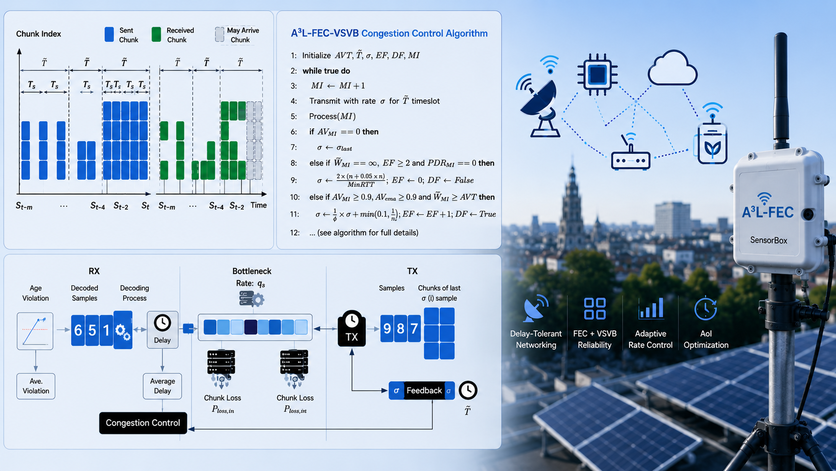
A³L-FEC delegates rate adaptation to the receiver, which is best positioned to observe network conditions. Within each monitoring interval it measures the age violation rate and the average chunk delay, smooths them with exponential moving averages, and adjusts the transmission rate accordingly.
- Empty queue → increase rate to refill the pipeline
- Persistent violations + high delay → reduce rate to clear congestion
- Bounded changes (capped increases, floored decreases) for stability
- Only fresh samples (within AVT) are eligible for transmission
Comparing the two variants
Both share the same core mechanism — packet-level FEC over UDP with receiver-driven, age-aware control — but differ in how updates are generated and transmitted.
| Property | A3L-FEC-FSFB | A3L-FEC-VSVB |
|---|---|---|
| Full name | Fixed Sampling rate, Fixed Block-length | Variable Sampling, Variable Block-length |
| Sampling rate | Fixed | Adaptive (generate-at-will) |
| Block length (n) | Fixed | Adaptive per monitoring interval |
| Sample selection | Stationary Independent Selection (SIS) over recent samples | One fresh sample generated every Ts, all n chunks sent |
| Age-violation estimation | Simplified per-slot counting | Refined estimate from generation/decode-time lists |
| Extra metrics | Avg. delay, age violation rate | + Packet Delivery Ratio, min-RTT, decrease flag |
| Adapts to dynamic networks | Limited | Yes — designed for it |
| Role | Simpler baseline | Full adaptive protocol |
| Best suited to | Stable / known link conditions | Variable, lossy, delay-tolerant networks |
Symbols: k data chunks · n coded chunks · AVT age-violation threshold · Ts sampling interval · σ transmission rate.
See it measured
Explore the simulation and emulation results, or read the full technical formulation in the papers.